Showing posts with label travel. Show all posts

6.24.2014

Lessons learned from travelling with a baby

Benoît after taking his malaria prophylaxis. Not sure how much actually got in.
Look at us, offering all this advice, as though we were experts!  A few people have asked us for tips for travelling with babies, so here goes...

1. When booking your seats on your flight, book an aisle and a window seat.   This is actually a great tip for anyone traveling as a couple, with or without a child. If the flight isn't full, people won't usually choose to sit in the middle, so very often you will wind up with an empty seat between you and your partner, where your baby can lie or sit.  Worst case scenario is that there is someone sitting in the middle seat, inc which care you just offer them whichever seat you like least (aisle or window) and you and your partner sit together.

2. If possible, book a room that has a separate living area, because if you don't, the fun ends when the lights go out for the baby's bedtime.  We've made this mistake twice now, and kicked ourselves for it.  As I am writing this, Dave and I are whispering to each other in the dark so that we don't wake the baby, who is asleep in the corner.  A balcony that you can hang out on is a close second to a separate living space.

3. Some people will say to make sure to nurse or feed while taking off and landing. We have never done this and haven't had a problem yet, but if you are having trouble with the flights, it might be worth a try. I think with the way that cabins are pressurized these days, the main reason that babies can be so fussy on flights is that their sleep schedules get so messed up and they are exhausted. So trying to make sure that they get enough sleep before/during /after has been the best approach for us, as well as feeding him when he gets hungry, rather than making him wait for takeoff.

4. Bring your carrier on the plane with you. I prefer a Baby K-tan, Dave likes the Ergo baby, either way, wearing the baby in a carrier is cozy for the baby and allows  you to use your arms and relax a little more. If your baby can sit up, some people really like bringing a neck pillow for the baby, so they can sit on your lap, lie back and relax.

5. Take the red-eye flight whenever possible - it increases the chances that your baby will sleep on the flight. The few times we have taken day flights Ben has been awake the whole time and its exhausting!

6. If possible, have one of you pre-board the flight with your carry on luggage to get everything set up while the other stays off of the plane until the last minute. The more time you can buy yourself off of the plane, the better.  Before take off seems to be when babies get the most fidgety so reducing your time on the tarmac helps.

7. Get to the airport early. This might seem like a no-brainer for a lot of people, but my motto has always been 'if you don't miss a flight a year, you spend too much time in airports'.  I pride myself on just how close I can cut it. But alas, running through the airport with a baby in tow takes way longer than it otherwise would, is way more stressful, and has made me rethink my policy. 

8. Baby meds (just in case): it might be worthwhile to bring baby tylenol (of the dye free variety so it doesn't get everywhere), or antihistamines these can sometimes be hard to find in the variety that you like when you are traveling.  Also, check well in advance what vaccines or prophylaxis your baby needs, sometimes travel clinics need to special order them and that can take some time.

9. Bring a comfortable head set or earphones. It can be hard to read with a baby in your arms, but its the perfect time to watch a movie. The movies that we saw on our last flights were the few movies that we have been able to watch in their entirety since Ben was born.

10. Bring a variety of baby clothes, swaddles, and a blanket on the flight. The temperature on planes can vary widely. The extra clothes help in case of an accident, too.

11. Bring extra diapers on the flight, in case it gets delayed (which flights in and out of NYC always seem to do)! 

12. Find out as much as you can about your flight, so you can either take advantage of the services provided or brace yourself for their absence. Our flight to Senegal (we're looking at you Delta) did not have bassinets or changing tables!

13. Finally, if you have any long car rides to take, it might be worthwhile to bring some formula ready to go in a bottle and a separate bottle of water. I say this because sometimes it can be hard to breastfeed - for example when you are stuck in traffic, and breastmilk doesn't always last that long, especially in a hot climate.  The nice thing about formula for these situations is that it can stay in powder form right up until the time when you need it, at which point you can mix in some water and its ready to go.

14. Have no shame! Do whatever it takes to make it through the flight. Here I am covered in a swaddle shushing like a crazy lady, but you know what?  It worked!
Left: Catee the friendly ghost, feeding and shushing, Right: Benoît snoozing in his carrier on our way to Barbados.

Finally, enjoy your trip!

PS: I am sure we'll update this post as time goes by, but feel free to ask any questions about our experience. Alternatively, we'd love to hear your advice...


5.26.2014

Senegal


We have just returned from a week in Senegal. Dave and I came along with me so that I could attend I workshop for capacity building of civil society, parliamentarians and the media in budget analysis and advocacy for the health of mother and child.

I hope I haven’t lost your interest already. 

Budget tracking may seem like a boring topic, but I find it so interesting.  For years now, countries across the globe have been saying that maternal and child health is one of their top priorities. Statements have been made, coalitions built, strategies have been developed. On the surface, it would seem as though a lot is happening. But when you look a little closer you find that despite all the rhetoric, little progress has been made in improving the health of mother and children, especially in the poorest countries in the world.

Ever since I have worked in this field,  every time we question why contraceptives are not available in the villages or why health centers are not staffed with qualified personnel, we almost always get the same answers: there’s no money, we don’t have the funding, and we can’t afford it.

A budget is the single best indicator of a country’s priorities.  It is the best way to tell whether a country is putting its money where its mouth is and whether or not it has taken steps towards fulfill the commitments that it has made to maternal and child health.

The three day workshop was attended by delegations from the Democratic Republic of the Congo, Niger, Mali, Burkina Faso and Senegal.  Each country was represented by members of civil society organizations and the media, along with parliamentarians, and their ministries of finance and of health.

The countries represented in the workshop have budgets that rank among the least transparent in the world. Of the countries represented, Burkina Faso’s had the best transparency score  in the International Budget Partnership’s Open Budget Survey – a measly 23 out of a 100, Niger, with the least transparent budget scored a depressing 4/100, with zero meaningful opportunities for civil society to contribute  to the country’s budgeting process. The survey evaluates the transparency of a budget by looking at what information is made public and when, as well as who gets to contribute to the process and how often.

The aim of the workshop was to have members of these delegations first understand the important role that the budget plays in reproductive, maternal, newborn and child health (RMNCH) and the financial costs of not investing in RMNCH. It also taught how good health policies are developed and costed, and provided options for increasing fiscal space – the money to fund these policies – within the existing budget.  A budget is public property, it represents the money that belongs to each and every citizen of a country and therefor, the public should have a genuine say in how the money is distributed and how is has been spent. This workshop provided participants with an outline of the steps that should take place in the budgeting process, and all of the opportunities in which civil society should be able to contribute. At the end, each of the delegations developed advocacy objectives and strategies to improve civil society’s contribution to the budgeting process in order to prioritize health.

A good friend of mine who works in finance once told me that talking about money scares people, that people often feel as though they don’t have enough knowledge to contribute and are too embarrassed to say so. That definitely explains how I have felt and I know some of the participants agreed. We were afraid that the workshop might be too long, too technical and hard to follow, but we could not have been more wrong. The participants lapped up every word on every slide, and were thrilled to be equipped with the knowledge of the role they can plan in ensuring that their country’s budget prioritizes maternal and child health.

The presentation on increasing fiscal space even got a standing ovation!

Ile de Gorée, Senegal
On a more personal note, attending a conference with my baby and husband was busy, to say the least, and stirred up a lot of feelings that I hadn't anticipated. When I returned to work at the beginning of April, I felt like I was struggling to be the parent that I wanted to be and struggling to do the job that I wanted to. I could no longer stay with the baby all day and I couldn't stay late at work either.  In many ways, the workshop only made these feelings worse.

Usually, when I attend a conference or workshop, I spend the coffee breaks networking with other agencies and donors, or helping out in some way. On this trip I spent my time running through the halls of the now-faded King Fahd Palace Hotel so that I could get back to the room to breastfeed. At the end of the day, rather than debriefing with other facilitators, I was stressing about getting back to Ben and Dave, who had taken a week off of his own work so that I could travel to Senegal. I felt like I was no just falling short at work and parenting but also at being a wife, and questioning if the trip had truly been worth it.   I worried about the precedent that I had set in my office: would other parents now be expected to travel when their babies are 4 months?  Would they be expected to foot the bill for their families to join, as I did?  Had I just done my colleagues a huge disservice? Then I started to beat myself up for being such an over-thinker: do I have to make all the right decisions all the time?  Does everything I do have to be perfectly feminist all the time? Why do I always second guess myself?

Am I the only one that does this, feeling guilty about feeling guilty?

Luckily, in the last days of the trip reminded me of another reason that I went to Senegal: I really do love traveling. After the conference ended, Dave, Ben and I went to Les Collines de Niassam, a beautiful eco-lodge three hours outside of Dakar, were we relaxed, bird watched, ate delicious food, went for a long walk to the salt wells, and took a boat ride, where we gorged ourselves on freshly picked oysters. It may not have answered any of my questions, but it sure was lovely. For now, it feels like it was the right decision to go.

Dave, relaxing on the balcony of our room at Niassam
Senegalese women harvest salt in Palmarin, Senegal


Salt wells in Palmarin 

 Benny came along for the ride.

A man cleaning his fields in Palmarin


Thomas, our boat guide and oyster-picker.
Freshly picked oysters
I think we had about 40 oysters each.


4.22.2014

You had me at Dakar

Boabab at dawn (Shahidul)
About a month ago, the week before I was set to return to work, my boss called to tell me about a workshop taking place in Senegal at the beginning of may. She was all, "There is this budget tracking workshop in Dakar, it would be so great if you could go, but no... its too early. Forget that I mentioned it, its no big deal.  Sigh.  It would just would be so great if you could go". The truth is that she had me at Dakar. From that point on, it was really more of a question of how to make the trip work with Benoît than whether or not I would go.  Travelling is sometimes the bane of my work existence - it can be really disruptive to my personal life - but it is also one of the parts of my job that I cherish the most, seeing new countries and meeting new people, it also helps me to better understand the contexts in which my colleagues work.  In some respects, my greatest professional asset has been my willingness to travel.  Ever since I got pregnant I have been wondering just how I would balance work with family, so I was eager to figure out how to get to Senegal with a four month old, 100% breastfeeding baby.

I was pleasantly surprised by just how many people were supportive of me travelling. Former colleagues and professional acquaintances were quick to share their stories of traveling with their babies, breastfeeding mid-conference, and to put me in touch with child care options. It was as though every mother that I had worked with wanted to show me that it was not only possible, but rewarding to have a travel-intensive job and have a baby.

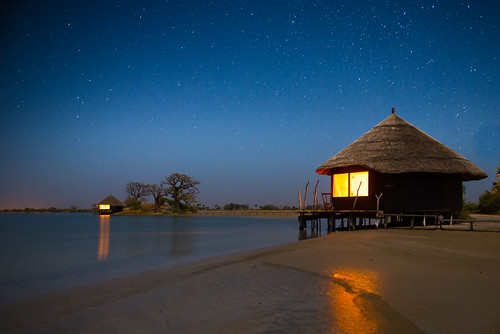
Stilt Houses at Niassam (Flickriver)
The only caveat that these travelling mothers had shared was that they had each brought along a travel companion, usually a mother, sister or spouse, to help with the baby while they were away. I resisted this option initially, mainly because of the cost. It seemed crazy to me to have to spend so much money to be able to work, especially if I could do it on my own, so I did the research on going solo: I found flights form New York to Senegal, found a hotel, looked up malaria prevention for babies, found childcare. I started out proud of myself and excited about the adventure, but as more and more logistical details became apparent (would the flight have a bassinet? would the cars accomodate Benoît's car seat? would he tolerate the malaria prophylaxis?) I began feeling like I was just planning on taking the trip alone because I wanted to prove that it could be done, when in reality I was starting to dread dealing with these challenges on my own.

In the end I convinced Dave to come with me. Neither of us have been to Senegal so we're going to make a vacation out of it. You only live once, right?  I am, however, very aware of what a privilege it is to have the ability to bring my husband along with me on a trip like this. I can't help but feel a bit uncomfortable with the knowledge that -let's be honest here- rarely do the salaries from my line of work allow for the spouses, mothers or sisters to come along. One needs an independent source of wealth to make bringing someone along doable. There is still another part of me that knows that doing this trip alone could have been done, but have to admit that it would not have been easy. No matter how much help I would have gotten from my colleagues it would just not be as easy for me to travel with a baby as it is for childless men and women.
Lake Retba (Geekologie)
In the meantime, Dave and I are starting to get super excited: after the workshop we are going to stay at Les Collines Niassam in a house built on stilts over a lagoon. We're looking forward to some fresh Senegalese seafood, to boabab trees (like the one above), a trip to Ile de Goree, and if time permits, a visit to Lake Retba (the pink lake above).  We'll let you know how it goes!


7.28.2013

Fire Island Will Never Get Old

Blue skies on the ferry ride.
When I tell my kids about Fire Island, NY,  I'll tell them it's a magical place that can only be accessed by boat, where there are no cars, and where dogs, babies, and deer run free. And I will be telling the truth.


There are few places that I can think of that are quite as relaxing as Fire Island. Dave and I have been trying to pin point just why that is - most people have wifi and you can check your cell phone on the beach, so its not like you are completely disconnecting from the world - but there is something about the pace at which one moves while in Fire Island that instantly slows your heart rate. As previously stated, there are no cars on the island, except for maintenance and emergencies, so the main modes of transportation are bikes and two-feet-and-a-heartbeat. The island is about the width of a long New York City block, and after your swim, you can stroll across it barefoot in less then three minutes. The beaches rarely get crowded, so there seems to be little incentive to rush anywhere. Even the (mostly) modest beach houses on the island seem to be telling you to just chill out for a minute.  

Being in good company definitely helps too.  This is the second year that we have had the good fortune of staying with friends in Fire Island. Last year we stayed at Todd and Margaret Muhlfelder's house, this year at Jesse and Pam Ellis's. Like last year, the six of us spent most of our weekend together, playing with kids and dogs on the beach by day and eating good food at night. A routine I am pretty sure I will never get tired of.
From left: Dave, Jesse, Pam.  Dogs: Saydie (ours, black fur), Elvis (Pam and Jesse's dog, white fur)
Saydie. I couldn't help myself.
Olivia Muhlfelder, 1.5 years old tests the waters, with her family's support. Photo by Pamela Ellis.
 How cute is that? Photo by Pamela Ellis.
Dave, Todd and Olivia. Photo by Pamela Ellis.
Elvis Ellis trying to chase Saydie down. Photo by Pamela Ellis.
Saydie hangin with her old pal Milo (Todd and Margaret's dog) after a long day of playing.
An Instagram photo from last year's trip: A deer and I check each other out on my trip to the market.
Fire Island Sunset. Photo by Pamela Ellis.

Also: check out this short BBC clip on architecture in Fire Island that just came out this past week. Thanks for sharing Andrew!

4.21.2013

Ivory Coast: Why I'm Here.

Two ladies in Wama, Ivory Coast, explaining to that they were circumcised, but their granddaughters won't be.

So. You’ve probably been wondering what exactly I am doing here in Ivory Coast.

I am here evaluating a female genital mutilation (FGM) prevention project.  I know, how light and uplifting, right? 

FGM refers to the practice of female circumcision, which can take many forms, but almost always involves the complete or partial removal of a girl's genitalia and in some cases also involves sewing up of the vaginal opening.  It is practiced across Sub-Saharan Africa, north-eastern Africa, and western Africa and in many Middle Eastern countries. With immigration it is also been recorder in many European countries, the US, Canada, Autralia and New Zealand.

The practice was first started out of the belief that a circumcised woman would not cheat on her husband while he was away. The practice can cause extreme pain, infections, hemorrhage, problems with childbirth, cysts, obstetric fistulas, sexually transmitted infections, and higher risk of newborn death. It can also cause psychological trauma, pain during intercourse and low libido.

I must say, I have known about FGM for a long time. I wrote a paper about it in college. I had seen cases in the hospitals in Chad and Ethiopia, but it was not until this trip that I truly absorbed just how bad the practice can be.

The project that I am evaluating is in a region called Séguela. Here, girls are circumcised after they have their first period. When a girl starts menstruating, her family begins to plan her circumcision and to arrange her marriage. In the year that follows, money is saved up and put aside in order to have a big celebration.  For that entire time, the girl must stay inside her home, as leaving is a sign of promiscuity that will not be respected by her community. On the day of her circumcision, the girl’s hymen is checked. If it is intact, she is paraded around her village and given gifts by her community.  She is then considered ready for marriage.  If her hymen has been broken before the ceremony, there will be no celebration and the girl will be shamed.

The people that I have spoken with say that the belief that a circumcised woman is more faithful remains, but that the practice of FGM also persists because it is a tradition passed down from generation to generation.  People worry that if they don't do it, people will think that they are poor or that their daughter is not a virgin. It’s also a celebration akin to some weddings in the western world – an opportunity celebrate and to show off wealth and one’s status in society.  In Séguela the practice is actually passed on by the mother and women have been the most resistant to stopping it.  They fear that not only that without it their daughter not be respected or able to get married, but that they themselves will lose status in their village.

All of this is bad.  Really bad. The arranged marriage, the idea that a woman who has had sex should be shamed, the idea that a woman should not enjoy sex. But the part that makes me cringe the most, is that this whole process takes place with absolutely zero anesthesia of any kind, and its usually a local woman with no qualifications at all that does it with nothing but a razor blade or a knife. In other words, its torture. Straight up.

One girl recounted the story of being pinned down by many women and blindfolded so that she could not see the woman who was cutting her. Now she says she is traumatized – she can’t talk about the experience without crying.

The good news is that there is progress being made.  This project and others like it, by collaborating with local NGOs, authorities, and cultural and religious leaders, has had some success in raising awareness about the risks involved with circumcision, as well as promoting gender equality and women’s rights.  In 2009 Séguela had an over 80% prevalence of FGM, in 2013, most of the younger women we spoke to said that they had not been circumcised and did not plan on circumcising their children.

My job here is to help measure this progress in order to inform future programs as there are still many communities that have not benefited from them.   By speaking with various community members, former practitioners, authorities and project staff, we can better understand what elements of the project were effective in reducing FGM prevalence and which elements were not.  This information will inform the design future FGM prevention projects. My personal goal, and why I do this kind of work, is that every project carried out be more effective than the one before it, and that we use every bit of information that we have to prevent FGM and the needless suffering that it causes from happening in the future. 

For more info please read this.

4.20.2013

Hotel Président, Yamassoukro, Ivory Coast


Last night on the way to Abidjan from Séguela, our my colleagues and I stayed at the Hotel Président in Ivory Coast's capital, Yamoussoukro. It was awesome.


The hotel was built by the government of the Felix Houphouët-Boigny, the first president of the Ivory Coast in the 1970s, presumably to cater to politicians and diplomats. When you walk through its front doors it feels as though you are stepping back in time. Everything is perfectly preserved. Eero Saarinen tables abound, as do those spectacular dome vanity lights.  The bathrooms are lined with orange and brown tiles and have Lucite cigarette holders next to the bidets.


3.08.2013

3 Days, 3 States and 3 Mountains

Dave hiking Mary's Nipple, Grand Targhee Resort, Alta, Wyoming.
We just completed an epic road trip - 3 days, 3 states (Idaho, Montana and Wyoming), 3 mountains (Sun Valley, Big Sky and Grand Targhee).

Yesterday we had a nice day of skiing at Big Sky and decided to head down to Grand Targhee where we heard they were supposed to be receiving anywhere from 5-10 inches of snow. The 4 hour drive through Yellowstone and Targhee National Forests was beautiful. We were enjoying the scenery until we hit a blizzard, which was a bit scary as we were forced to drive 10 mph with our hazards on.

Luckily we reached our final destination - the Super 8 in Driggs, Idaho - without incident.

The calm before the storm. Yellowstone National Park.
This morning started off with a bit of a hitch - I left the headlights on overnight and needed to get the car jump started - but we ended up having an amazing day of skiing at Grand Targhee.

Grand Targhee, located in Alta, WY, is known to be a great place for skiers seeking powder. It is in the snow belt and receives over 500 inches of snow each year. Also, being pretty out of the way allows skiers who can get there on a powder day to have their pick of fresh tracks all day.

Our first run was right off the main lift and despite being a good 30 minutes after the lifts opened to the public we got to lay down some fresh tracks. As we got back on the chairlift we were joined by a Targhee employee named Scott who had just finished working in the terrain park. After chatting with Scott on the ride up, he asked if we wanted to ski a run with him. One run turned into 3 hours involving hikes up Mary's Nipple and Peaked, a view of Grand Teton, and some first tracks in fresh powder with nobody in sight.

Catee Hiking Mary's Nipple.
After an epic day of skiing we hopped back into the car and completed our road trip with some beef jerky and a 4 and a half hour drive back to Sun Valley.

You know you are in Idaho when...

It's nice to finish a road trip and still be on vacation - we have three more days in Sun Valley before we head home.

No explanation needed.

3.07.2013

Driggs, Idaho

Big Southern Butte, Snake River Plain, Idaho.
After a lovely dinner with Jenn at Montana Aleworks, a great day of skiing at Big Sky in Montana, and  hours of driving listening to This American Life and the Current, we have arrived in the Super 8 (my favorite- I love motels!) in Driggs.  Now we're unwinding watching Forrest Gump, getting ready for another day of skiing.

Somewhere in Idaho!
Yellowstone National Park, Montana.
Arco, Idaho.
Arco, Idaho
Arco, Idaho.
Near Big Sky, Montana