
Showing posts with label Haiti. Show all posts
Showing posts with label Haiti. Show all posts
12.19.2012


Tennis?!
I have to confess. I’ve always thought that tennis is pretty bougie. The preponderance of cable knit sweaters at
the US open only confirmed my suspicions.
Fast forward a few years to 2011. When I first arrive at Villa Creole in Haiti, the hotel had signs everywhere for a tennis court out back. One day my friend Cristina and I followed signs to find a refugee camp where the courts once were. After the earthquake, nearby residents who had lost their homes had relocated to any open space available, including the courts.
 |
| Wilnes. |
As a kid I never any real desire to play – prancing
around in a tiny white skirt just wasn’t my thing.
Fast forward a few years to 2011. When I first arrive at Villa Creole in Haiti, the hotel had signs everywhere for a tennis court out back. One day my friend Cristina and I followed signs to find a refugee camp where the courts once were. After the earthquake, nearby residents who had lost their homes had relocated to any open space available, including the courts.
By mid-2012, the people living in the courts had been relocated to shelters in the hills behind them (this kills me - that people call their homes shelters, and that it is the appropriate thing to call them). The courts had reopened, and
one of the men who had lived on the courts had taken them over. His name is Wilnes, and he also offers
lessons. Cristina happily started to
play when she would come, and highly recommended them to me. At first, I politely declined. The thought of staying at a fancy hotel and
playing tennis while in Haiti was just too much for me. But then, on my last
trip, after nights and nights sitting in from of my computer and avoiding the
treadmill, I needed physical activity and social interaction. I caved, and took a lesson.
To my surprise, it was really fun, and just
what I needed. For someone who absolutely loathes working out, it is really
perfect for me – just social enough, outside, and requires enough attention
that I don’t get bored out of my mind
while I am doing it, as I would on a treadmill or the elliptical. Don’t get me wrong: I still haven’t gotten
over my squeamishness about the preppiness of the sport, and probably won’t be wearing
a little white skirt any time soon. But
for now, I am happy to have found something fun to do to pass the time while I
am here.
 |
| Wilnes' shelter. |
12.18.2012
So long Jacmel

Today I start the long road home. I leave Jacmel for Port Au Prince this afternoon, and then will be back in NYC tomorrow night.
When I am here I am torn between being totally in love and wishing that I could stay longer - because of my work, I never know if I will be back. At this very moment though, I must be honest, I am ready to get back to Dave, the dog, and our new home.
12.17.2012
Just throwing this out there: I am pretty pissed about the cholera epidemic in Haiti.
 |
| image from Reuters. |
Almost 8000 people have died since it
started in October of 2010. A crazy,
huge number. The biggest of any cholera epidemic in recent history.
The craziest thing is that it was brought
here by an organization with an internationally recognized mandate to protect Haitians.
My complaints have nothing to do with the
fact that the strain of cholera was Nepalese.
It’s about how this has been portrayed in the media by some – as though
there was just one poor innocent Nepalese soldier that inadvertently caused the
whole epidemic – poor guy, he came here to help. Let’s not blame him.
The reality is that it is highly unlikely
that a one infected person could cause such an explosion of cases of cholera. The much more likely scenario, all but confirmed
by the CDC, is that at the Nepalese base, the UN was dumping its untreated
fecal matter into a river, which acted as a water source for the people leaving
nearby.
This is criminal negligence of massive
proportions.
Think of the repercussions if this had happened
in the US. BP was fined 4.5 billion USD for the oil spill, and they face civil
trials on top of that. That kind of money would be incredibly useful for Haiti, the poorest nation in the western hemisphere. But who's kidding who? It would be really useful for any country, particularly in a crisis like this.
Whereas it was not there before, Cholera is now here to stay in Haiti. The prevention mechanisms in places are abysmally weak. The treatment mechanisms just as bad. You can read my previous post to find out more about why.
Whereas it was not there before, Cholera is now here to stay in Haiti. The prevention mechanisms in places are abysmally weak. The treatment mechanisms just as bad. You can read my previous post to find out more about why.
The largest NGO in the world needs to be
held accountable to the Haitian people, and to its donors and member states. It needs to know that it cannot get away
with this kind of negligence, not in a developing country, not ever. By not holding the UN accountable, we are
sending a clear message to the developing world that the standard code of
conduct that applies to us does not apply to them. That we punish those who run us (people of
wealthy nations) afoul, but we ignore it when it happens to the poor.
*** update: please read this FP article about the UN, cholera and Haiti. Unbelievable.
*** update: please read this FP article about the UN, cholera and Haiti. Unbelievable.
12.14.2012
Talkin’ about poop.
 |
| This picture has nothing to do with poo. I just like it. |
For the last two weeks, my colleagues and I
have been travelling Haiti, talking to people about poop. We ask them where
they poop, how they wipe, if they wash their hands, and if they have toilet
paper, water or soap.
What we are learning is that a lot of
people, particularly the rural poor, don’t have latrines, and even less people have soap and water. This is outrageous for a country that is 2.5
years into the worst cholera epidemic in recent history.
Cholera is transmitted by fecal oral route,
meaning literally when feces enter the mouth.
This sounds gross – and it is – but it’s really much easier for this to
happen then one would think. If you don’t
have a latrine and you need to go to the bathroom outside, often the poop can
then be blown or carried with rain into a source of water, which people then
drink from (no they are not literally drinking poo – but they are drinking
water that has touched poo, and that carries the bacteria).
 |
| Cholera can also be spread when feces touch fruits and vegetables which are then eaten. |
Having a place to poop is a really
important part of stopping the spread of cholera and everyone that we speak to
knows this. The people who don’t have
their own toilet express great shame in not having one. The problem is that for many they are just
too expensive. When we ask people about
their priorities, they are clear: send my kids to school, fix the house, maybe
buy a motorcycle so that they can get into the city to find work. A latrine is understandably not high up on the
list, especially when they have survived just fine without one until now.
Giving people latrines sounds like a
no-brainer, and in some respects it is.
Everyone should have one. But
nothing is that straightforward in Haiti.
There is no piped water system in much of the country, so the kinds of
toilets that we have in our houses are pretty much out of the question. Dry pit latrines (just like outhouses) are
the simplest solution but they can smell, and eventually they fill up and a new
hole needs to be dug. An intermediate model uses water to flush, but doesn’t
need to be hooked up to plumbing. All of these types will require emptying or
re-digging within a few years, and that kind of service is not readily
available. Then you have to make sure
that whatever style of latrine you chose can withstand all of the hurricanes
and tropical storms that Haiti gets annually.
Many of the latrines that we saw completely collapsed during hurricane
Sandy.
After you have chosen your environmentally
friendly, hurricane-proof latrine (please share if you succeed!), you need to
make sure that there is water nearby so that people can wash their hands. This is a whole other feat in and of itself,
especially way up in the mountains. Then
you need to make sure that people have a steady supply of soap to wash their
hands, and Clorox to clean their latrines.
Now that you have all of the hardware set
up, you need to work on the software: making sure that people use their latrine,
that they clean it, and wash their hands. Laugh if you will, but if this was so simple
you wouldn't find “employees must wash hands before returning to work” in every
restaurant bathroom.
Behavior is hard to change. It takes a long time. If all people needed to
change their behavior was knowledge, no one would smoke, we would have stopped
the spread of AIDS, and obesity might not exist. People need repeated, ongoing reminders of
what to do, and they need all the systems to be in place to facilitate them
making the right decisions. We asked one of the project staff how long it takes to create sustained behavior change and he responded, 'It takes a long time. Very long. Until death.'
In Haiti, many people don’t have
latrines. They can’t afford soap. They have to walk long distances for water.
The systems just are not in place to stop the spread of cholera.
My job, as an evaluator, is to help
organizations navigate complex situations like these. I am part of a team that helps organizations to learn from their past experiences and to apply that knowledge to best meet the needs of their beneficiaries,
in this case Haitians.
 |
| The team, crammed into the back of a land cruiser. |
12.13.2012
Haitian Picture of the Day
Beautiful picture
A sail boat off the coast of Petite Rivière de Nippes, Haiti

It reminds me of some of the Dhows we saw when we were in Lamu, Kenya.
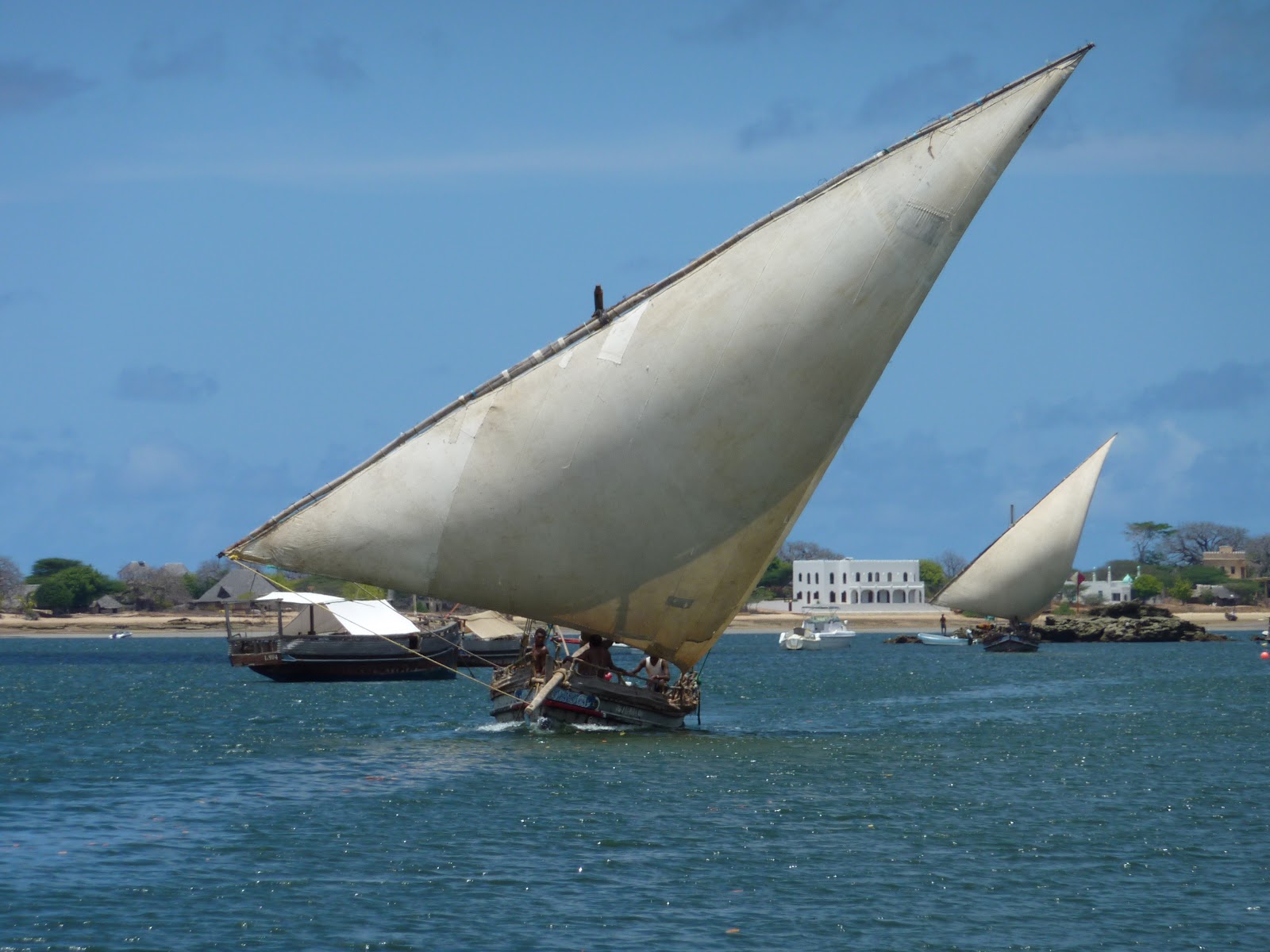

A sail boat off the coast of Petite Rivière de Nippes, Haiti
It reminds me of some of the Dhows we saw when we were in Lamu, Kenya.
12.12.2012

12.09.2012
I hiked two hours to get to work today.

Ok, that's not true. I was going to hike two hours to get to work today, until I found out that I could take a motor bike part of the way and then I'd only have to hike for an hour. I mean, I like hiking and all, but a two hour hike in addition to a one hour drive is a bit extreme.
Until a couple of months ago I would have been able to drive most of the road in a car, but our good friend Sandy just knocked the road clear off of the side of the mountain. So walking and motorbikes it was.
 |
Thanks Sandy, I'm sure the villagers won't miss this road.        |
12.05.2012
Catee is in Haiti
Some of us are sad that Catee has left for Haiti.

But we will persevere.
Dave's To Do List:
Wish me the best!
-Dave
TO DO LIST UPDATE
Figure out how to get rid of all of the debris from our demolition this past weekend - CHECK!


But we will persevere.
Dave's To Do List:
- Figure out how to get rid of all of the debris from our demolition this past weekend
- Schedule the structural engineer
- Get estimate for chimney repair and central air
- Get estimate for structural work from contractor and try to get work scheduled - hopefully before the new year
- Work with Les (our architect) to finalize drawings
- Feed and walk the dog
- Don't kill the plants
Wish me the best!
-Dave
TO DO LIST UPDATE
Figure out how to get rid of all of the debris from our demolition this past weekend - CHECK!

11.14.2012
Barber shops and beauty salons
One of my favorite things about Port au Prince is the handmade signs all over the city - especially barber shops and beauty salons! Here are just a few from this trip.


 |
| Oh man - I wish I had this whole picture! |

11.12.2012
Panorama Mania
Panoramic views of Port au Prince and much of Haiti. Please click on them to view in slideshow mode. They are much nice that way.

 |


 |
| A house that Baby Doc built, but that was later abandoned. |

 |
| When we arrived at this lookout the city was covered in low clouds... |
 |
| Clouds lifting. |
 |
| Gone! |
10.31.2012
My Daily Commute

I wish I could tell you that while I am in Haiti I travel freely. That I am ‘one with the people’. That I really know Haiti. But the truth is, I don’t.
Look closely and you can see the reflection of my phone in the pictures. Most of them were taken from the inside of my big white air conditioned prison, a Toyota land cruiser.
Every time I come here I tell myself that I should do things differently, that I shouldn’t stay in a nice hotel, that I should get out more. But then I don’t. The security is not great. My trips are planned in a hurry, my days are full and so are many of my nights. Plenty of empty excuses. Next time, next time.
My morning commute is usually spent clinging to the door, cringing, covering my eyes, peeking through my open fingers. Admittedly, I think that Alex, my driver, is crazy. That, and I can be a nervous nelly in a car. We share the road with so many others: cars and buses, people, goats, chicken, dogs. Oh! So many puppies. I used to scare Alex with my gasping every time we drove near one. He would slam on the brakes, “qu’est ce qu’il y a?!!” “What??” He would ask. Now he just laughs at me and pins the gas.
Luckily, the trip is interesting. We never take the same route twice. Alex knows the city and its steep, winding vein-like roads and alleys like the back of his hand. Every day we drive up tree covered slopes, hug the corners atop sharp drops, fly past markets and art displays. Most of all, we sit in bumper to bumper traffic, horns blaring, cursing at the other drivers who are even crazier than Alex.
This trip, though the driving has not changed, I have. I suddenly have this sinking feeling that I may not return to Haiti, and a desperation to capture what I can of it before leaving. I used to get irritated with people snapping pictures all the time. I thought it was distracting and disrespectful. Now I find myself in a frenzy of picture taking, desperate to catch every ounce of the city’s color before I go.


 |
| (Alex) |
Subscribe to:
Posts (Atom)